Pixel LEDs have become popular for decorative lighting, LED displays, signage, festive decorations, architectural lighting, and programmable lighting projects. Among the most commonly used addressable LED types are WS2811 and WS2812B Pixel LEDs.
Although both support individually controlled lighting effects, they differ in their design, wiring, voltage options, control method, and applications. Understanding these differences can help you choose the right Pixel LED for your project.
What Is a WS2811 Pixel LED?
WS2811 is an LED control IC commonly used with external RGB LEDs. The controller receives digital data and controls the brightness and color of the connected LEDs.
WS2811 Pixel LEDs are available in different physical forms, including Pixel Jhalar, strings, modules, and waterproof decorative lights.
A major advantage of WS2811 is its availability in 12V versions, which can be useful for longer LED installations because higher voltage can help reduce voltage-drop issues compared with low-voltage systems.
Key Features of WS2811
- Addressable RGB lighting
- Digital data control
- Commonly available in 12V configurations
- Suitable for long decorative LED installations
- Compatible with various Pixel LED controllers
- Available in different LED shapes and packaging
- Useful for Pixel Jhalar, signage, displays, and decoration
What Is a WS2812B Pixel LED?
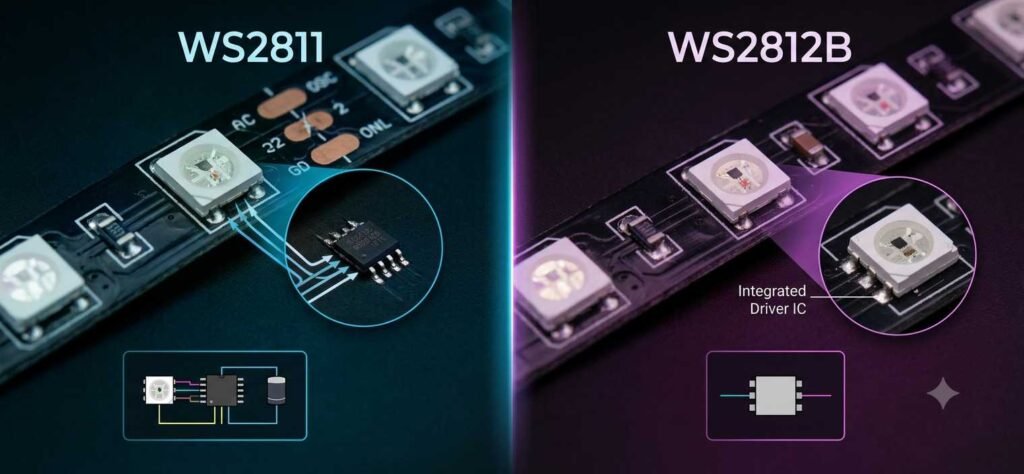
WS2812B is an addressable RGB LED where the LED and control IC are integrated into the same package.
Each LED can receive digital data and display a specific color. This makes WS2812B particularly popular for programmable LED strips, DIY electronics, Arduino projects, displays, and other individually addressable lighting applications.
WS2812B products are commonly available in 5V configurations.
Key Features of WS2812B
- Individually addressable RGB LEDs
- Integrated controller IC
- Generally operates at 5V
- Simple digital data connection
- Suitable for LED strips and compact lighting projects
- Works with Arduino, ESP32, Raspberry Pi and similar controllers
- Supports colorful programmable lighting effects
WS2811 vs WS2812B: Main Differences
The biggest difference is how the controller IC and LEDs are implemented.
| Feature | WS2811 Pixel LED | WS2812B Pixel LED |
|---|---|---|
| Controller | External WS2811 IC commonly used | Controller integrated into LED package |
| Common Voltage | 5V / 12V variants available | Generally 5V |
| LED Integration | Separate LED and controller | LED + controller in one package |
| Addressability | Depends on product configuration | Individually addressable |
| Wiring | Can vary by product | Usually simple 3-wire connection |
| Long Installations | 12V versions can be advantageous | 5V requires more attention to voltage drop |
| Common Uses | Pixel Jhalar, signage, decoration | LED strips, displays, DIY projects |
| Installation | Available in various outdoor formats | Commonly used in compact LED formats |
1. Voltage Difference
Voltage is one of the most important considerations.
WS2811 Pixel LEDs are commonly available in 12V versions, although 5V versions also exist. A 12V Pixel LED system can be convenient for longer decorative installations.
WS2812B is generally designed for 5V operation. Because of the lower voltage, voltage drop can become more noticeable over longer LED strips or installations.
Always check the manufacturer’s specifications before connecting a Pixel LED to a power supply.
2. Controller IC Difference
With WS2812B, the control circuitry is integrated directly into the LED package. This makes the product compact and reduces the number of separate components required.
WS2811 is a separate controller IC that can be used with external RGB LEDs. This gives manufacturers flexibility in designing different Pixel LED products.
3. Wiring Difference
Both types generally use digital data communication and power connections, but the exact wiring depends on the product.
A typical WS2812B setup uses:
- VCC
- Data
- GND
WS2811 Pixel products may have different wiring arrangements depending on whether the product uses 5V or 12V and how the LEDs are configured.
Therefore, always check the product wiring diagram before installation.
4. Addressable Lighting Effects
Both WS2811 and WS2812B can be used to create dynamic lighting effects such as:
- Running lights
- Rainbow effects
- Color-changing patterns
- Chasing effects
- Flashing effects
- Music-reactive lighting
- Programmable animations
- Decorative sequences
The actual number of individually controllable LEDs or pixels can depend on the specific product and its configuration.
5. Which One Is Better for Long Installations?
For longer decorative installations, a 12V WS2811 Pixel LED can be a practical choice because the higher system voltage can help manage voltage drop.
However, voltage drop depends on many factors, including cable length, LED power consumption, wire thickness, current, and power-injection design.
WS2812B can also be used for larger projects, but 5V installations generally require more careful power distribution and power injection.
6. Which One Is Better for DIY Projects?
WS2812B is often a convenient option for DIY electronics projects because the LED and controller are integrated into a single package.
It is widely used in:
- Arduino projects
- ESP32 lighting projects
- LED strips
- Smart lighting
- Small LED displays
- Wearable electronics
- Decorative DIY projects
WS2811 is also suitable for programmable projects, especially when using Pixel LED strings, modules, or other outdoor decorative formats.
7. WS2811 vs WS2812B: Which Should You Choose?
The right choice depends on your project.
Choose WS2811 if:
- You need a Pixel LED for decorative or outdoor installations.
- You prefer a 12V Pixel LED system.
- You are creating Pixel Jhalar or large decorative lighting.
- You need different physical LED formats.
- Your project requires longer cable runs and practical power distribution.
Choose WS2812B if:
- You are building a DIY programmable lighting project.
- You need compact addressable LEDs.
- You are working with 5V electronics.
- You are creating LED strips or small displays.
- You want an LED with the controller integrated into the package.
Conclusion
Both WS2811 and WS2812B Pixel LEDs are useful solutions for programmable RGB lighting, but they are designed with different approaches.
WS2811 offers flexibility and is commonly found in 12V Pixel LED products, decorative lighting, Pixel Jhalar, signage, and larger installations. WS2812B integrates the controller into the LED package and is widely used for 5V addressable LED strips, DIY electronics, displays, and compact lighting projects.
Before choosing a Pixel LED, consider the operating voltage, installation length, power requirements, controller compatibility, wiring, LED density, and intended application.
For decorative and commercial lighting projects, selecting the correct Pixel LED voltage and compatible controller is especially important for reliable performance and long-term operation.